Remembering Edith Cavell

edith_cavel_memorial_-_statue
Statue of Edith Cavel on the Edith Cavel Memorial, Westminster Author Prioryman (https://commons.wikimedia.org/wiki/User:Prioryman) This file is licensed under the Creative Commons Attribution-Share Alike 4.0 International license. (https://creativecommons.org/licenses/by-sa/4.0/deed.en)

If you find yourself in Trafalgar Square, take a stroll uphill toward Leicester Square, give a nod to St Martin-in-the-fields and when you’re just about opposite the National Portrait Gallery entrance, you’ll find yourself looking at a memorial statue to one Edith Cavell.

Like any city where you may spend a size-able amount of time either working or living, it’s easy to grow accustomed to the various memorials that may be dotted along your daily route but this one is worth stopping for.

In the First World War, Edith Cavell was a nurse in Brussels with a well-earned reputation for training younger nurses from neighbouring hospitals, schools and kindergartens. When the German army occupied Brussels, she and colleagues began sheltering British soldiers followed by French soldiers and then Belgian and French civilians. She would care for them and provide them with money before directing them to the Dutch border. Her actions, however, meant that she had violated German Military law and nearly a year later she was arrested, charged with treason, brought before a court-martial and with a confession she had given freely, found guilty. The sentence was death by firing squad. On the day before the sentence was carried out, she stated, “Standing as I do in view of God and eternity, I realise that patriotism is not enough.
I must have no hatred or bitterness towards anyone.” Words enshrined in the memorial.

She was executed on 12 October 1915.

There is no doubt that countless men and women have paid the ultimate price in serving their countries over the years but to fight back while refusing to take up arms or kill, knowing what the dangers are, takes a particular strength and resilience. One that still inspires today.

Machine Block

Beijing boasts the CCTV building, an astonishing piece of architecture (1) which regardless of whether or not people like it, is sure to spark debate. Closer to home, London continues to grow upwards with new buildings boasting new designs not all of which are as imaginitive, most simply being glass skins wrapped over metal frames.

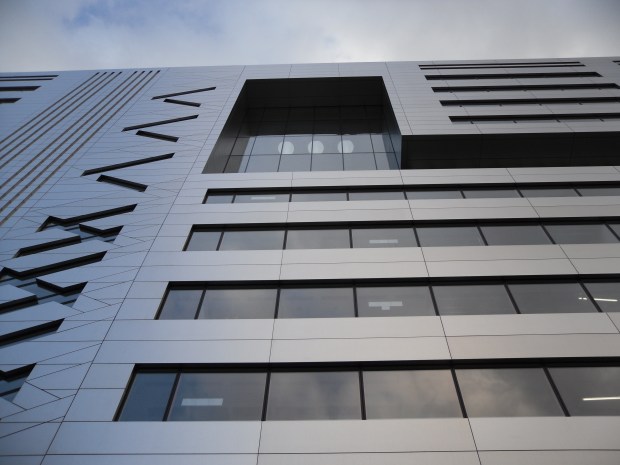
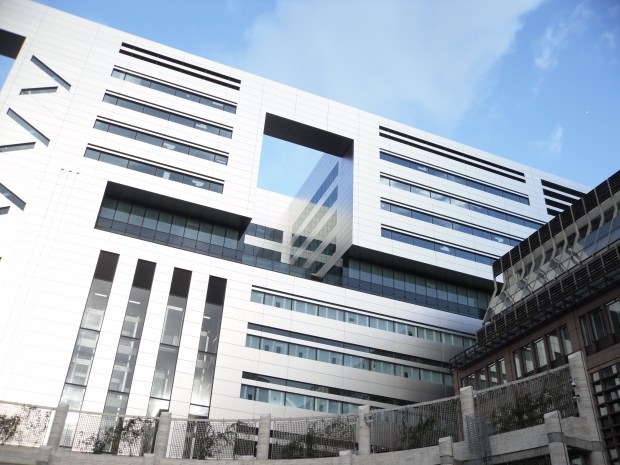
Number 5 Broadgate however seeks to be a little something of its own. SAM_4867Designed by Ken Shuttleworth of Make Architects (2) for client UBS, it stands next to Liverpool Street Station as a brand new model of machine engineering. Which is exactly what tries to emulate. SAM_4876Boasting “the form of a perfectly machined metal object” (2), the building reflects internal processes with external stainless steel marked with exacting gaps and openings. SAM_4869It also boasts a green credential with carbon emissions some 65% lower than the previous two buildings on the same site(3).

SAM_4875

1 http://oma.eu/projects/cctv-headquarters

2 http://www.makearchitects.com/projects/5-broadgate/

3 http://www.broadgate.co.uk/5-Broadgate

Old dog, new tricks

Is it possible to take something iconic and breathe new life into it? Apparently, yes. Britain is known the world over for the red telephone box. Tourists come from all over the world and are hard pressed to go home again without having their photos taken alongside these examples of historic technological wonder.

Plans for the telephone boxes go back as far as 1912 according to the website, The Telephone Box (1). After some delays and design failures, the 1920s saw the early versions of what we’ve all come to know and love since. The advent of mobile phone technology however has seen their usefulness decline over the years and in more recent years, decline dramatically. Although it would seem not everyone is ready and willing to let them fall by the wayside just yet.

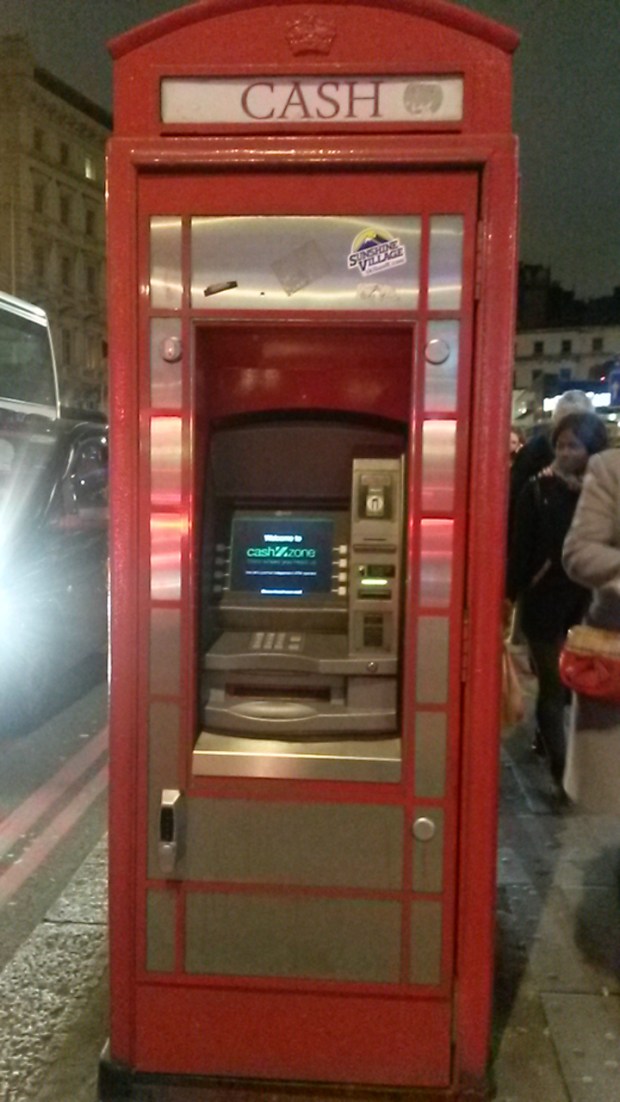
In Knightsbridge, one of these old dogs has been taught a new trick, that of becoming a cash machine or ATM. Clearly, for some this might be seen as sacrilege. To take something that has such cultural significance and reduce it to a mere token device. But would it not be fair to suggest the public telephone was a token device in its own right? Its original purpose has been surpassed by new technology surrounded by a robust new industry. One that isn’t going to go away now or in the future. Is it not possible for museum pieces to have a functional purpose too?

20151205_173627

1 http://www.the-telephone-box.co.uk/


The Changing Face

Walking through the city, I came across the stencilled work of the graffiti artist known as “Banksy”. I had seen it before and it was in the same place I had seen it but this time it was different although what exactly was different about it I couldn’t say. The rat with the “I love London Robbo” sign stared impassively back at me and dared me to make the connection.20151130_115810

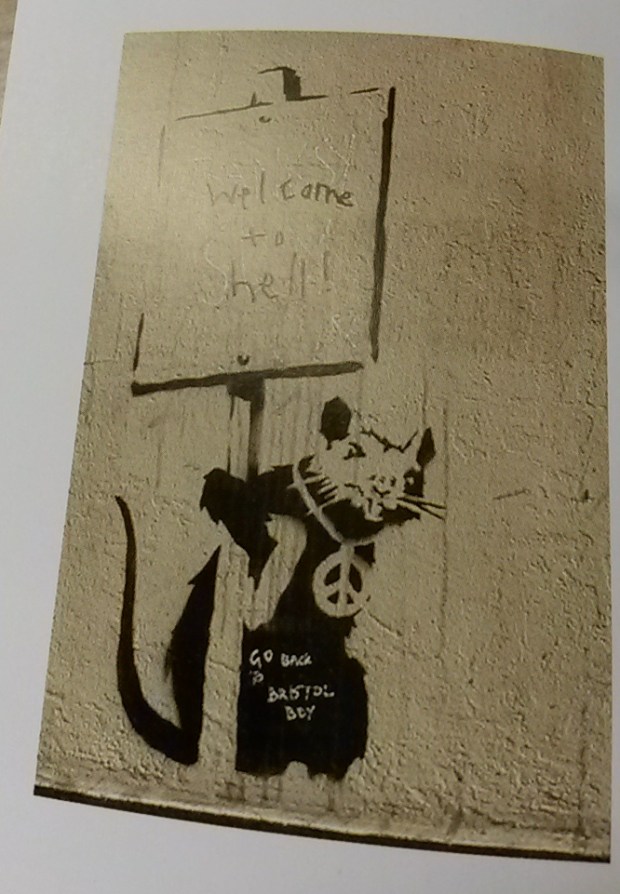
Looking through the artist’s book, “Wall and Piece” (1) I did find and image of the original (2) where it was listed albeit with a different message on the sign, this time saying “Welcome to hell”. 20151202_134803Whether this was the artist recreating the original with a different message or a copycat is a question that will likely never be answered but it does point to the transient nature of graffiti art. It’s a form of expression with a “Use by” date inherently attached. By its very nature, it is not something that can be retained and discussed for years to come even if the artist is widely respected although some have attempted to circumvent this by removing the wall itself for auction at a later date. Inevitably, someone, usually the authorities will go about the process of removing the piece, either by cleaning it off or by painting over it.

Another artist, known as “Mobstr” (3) chanced upon a means to exploit this process. His daily commute took him past a particular wall where a section was painted red. Noticing that graffiti on the red section was painted over with more red paint while graffiti on the rest of the wall was cleaned by high pressure water hose. Over the course of a year, he taunted the local authority by painting a singular word “RED” – in black paint – over the red part of the wall.

5
Photo from Mobstr website.

On each occasion, it would be painted over and he would repeat it, moving slightly further up each time until he wrote on both parts. His website documents by way of photographs, the course of the year leading to a remarkable (and hilarious) conclusion. Click on the link below to see what happened.

1 Wall and Piece Publisher: Century; New Ed edition (9 Nov. 2006) ISBN-10: 1844137872

2 “Welcome to hell” photo taken from (1)

3 http://www.mobstr.org/red/


The City, Programmed

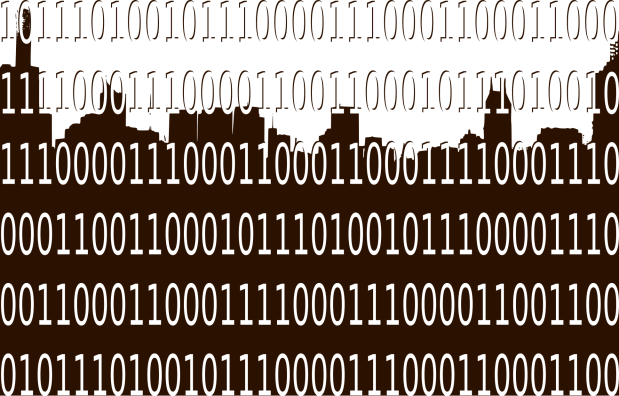
CityProgrammedThe modern city has reached a new pinnacle along the route of inevitable progress. The networks that have become imperative to the day to day running of the city, the electricity, gas and water supplies, the street-lights, communication, roadworks, plumbing, sewage and refuse collection. Emergency services, municipal services, local tax collection and allocation, all these and more are run by computers, programmed to run programmes. They automate and facilitate. Systems that allow other systems to run programmes interconnecting, communicating, greasing the wheels needed to turn to allow for services and bureaucracy, both. The city has come to re-define organic. This demi-gaia of overlapping tributaries, networks of elements, cables and precious metals has become an organism in its own right.

The computer, the most fundamental requirement that allows the services to run at the rate we require is feared and elevated in equal measure while the software that runs it is considered in hushed tones and is only for those programmers who understand it. But the software is only the end product of a process that consists of programming languages that appear almost as numerous to the uninitiated as the number of languages spoken by people around the world. It is disconcerting that so many people choose to consider that something so fundamental to their lives is also too far beyond their limit of understanding as to warrant an escapist approach by which understanding is not even attempted. This is even before we explore those means by which people actively take part in the digital universe: interfacing through computers; laptops; tablets; smartphones; smartwatches; kiosks and the like. At every stop, leaving a trail of breadcrumbs, whole encyclopedias of data which relate to everything we do and are there, for the taking, to anyone who wants them.

The programmer, therefore, is a member of one of the most powerful groups active in the world today. A community of makers who fashion the fabric of the modern infrastructure. The programmer is the creator, the maintainer, the controller of the city. While the politicians, businessmen and special interest groups who purport to drive the direction of the infrastructure of the city, act merely as priests bringing offerings to the temple. As Robert (Uncle Bob) Martin explains (1) this status quo will inevitably lead to the code, and the programmer, being held accountable. He calls for the practitioners themselves to consider what they do a profession and to organise themselves as such before the legislators are forced to do so. These “practised hands” (2) wield both a wonderful and potentially terrible power over the world.

For generations we understood that our interactions had ramifications with those around us but we lived in smaller communities and we could believe that what we did behind closed doors stayed there. None of the doors are truly closed in the connected world, however and being connected makes each of us part of the city, real or virtual – it doesn’t matter. The city, with the vast sprawling infrastructure, has a great deal to offer but the potential pitfalls demand we fashion smarter attitudes to accompany our smarter phones, televisions, fridges and the like

1. http://blog.cleancoder.com/

2. McCullough M 1998 A digital craft. The practised digital hand MIT Press, Cambridge, MA

Original image – City Skyline by rgesthuizen via OpenClipArt.org https://openclipart.org/detail/8115/city-skyline

The Electric Urbanite: OpenStreetMap.org

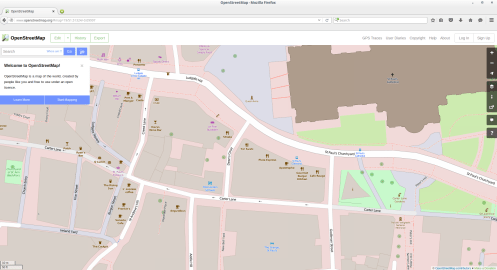
A recent post by Jeff Allen (http://motherboard.vice.com/read/the-little-known-capitalist-history-of-the-highway-map?utm_source=mbtwitter) sought to describe the influence of cartography in the expansion of capitalism and empire. It’s a fascinating piece detailing how maps have influenced peoples’ choices helping to determine which routes to take based on where they might stop for fuel, food and the like, taking the innocuous and turning it into a means of determinism for governments and businesses alike.Openstreetmap

Equally fascinating, however, is the developments brought about in the internet age. An era where free and open source software (determined by the unrestricted access to examine, amend and re-distribute the code) has become the underpinning framework for the web. The free software movement has expanded into other facets including free culture (https://copyleft.org / http://creativecommons.org/). Given that most maps both online and off are governed by copyright, the open culture has reached into cartography, too. This time, in the form of Open Street Map (www.openstreetmap.org).

Initiated by Steve Coast (http://stevecoast.com/) with a similar approach to Wikipedia, volunteers use a variety of resources from ordinance survey maps to GPS records to public domain satellite imagery along with their own, local observations and knowledge to build a rich, freely available and distributable resource, initially of the United Kingdom but also fast including areas further afield.

It’s a fascinating development. Not only does it provide an open alternative to established resources, free of political or commercial interests, it elevates and democratises the input of all users. Since anyone can open an account and edit the maps, providing a first-hand perspective to a particular location, such as “extensive potholes” or “coffee shop”, it becomes a canvas that is being constantly refreshed. It is almost a virtual wall, open to the graffiti of all who visit where the only restrictions being information that is disputed.

As this takes place in cyberspace, it vastly diminishes some of the other hurdles that have previously held back the input of others. It does not require an ongoing subscription. An account is required to edit maps but this is free and does not have to be in your own name. Having made the contribution, you need never log in again. This means there is no barrier to entry, anyone is free to make contributions regardless of their financial backgrounds, geographical location, political or religious viewpoints. The one real requirement is internet access, something which is becoming ever more ubiquitous. Here, the Electric Urbanite has a role to play in the world around them and they’re stepping up to the task.

Sub-urban Branding

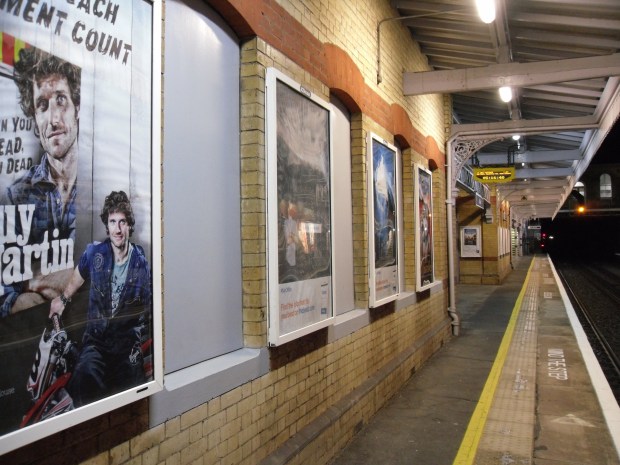
SAM_4854In a quiet corner of outer London, a village that by the early hours has closed down its recognition of the sounds of city life, the local train station shares the growing adornments that have become all too common. Like much of the advertising world’s accoutrements, these are nothing new but as Kurt Iveson (1) put it, the difference is in the quantity and the form of the advertising.
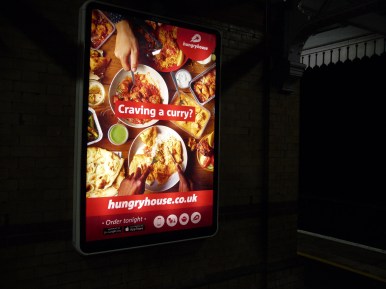
In this sleepy, village station, a multitude of posters have taken to the walls like a growing menace. A trestle ivy of advertising wares that seek to ensure there is no respite from their ever-growing need for attention. And in case you had become accustomed to the point of forgetting their existence, a new step in evolution has come out of the shadows, the back-lit poster. SAM_4856This is not an advent like that found in the most electrified parts of the city such as the underground where electronic screens display moving images or the giant screens at the centre but it is an indication that the evolution of affordability has taken the early steps into the suburbs.
Here the station that, like the village that surrounds it, was once a quiet haven from the hustle less than an hour away has begun to know some of that hustle. The evolution promises that the tide is turning. The cost of erecting brighter, bigger ads further and further out of the city is falling all the time. As is the cost of maintaining them.

The signs have not been hidden. Indeed, they’re there for all to see.

(1) Branded cities: outdoor advertising, urban governance, and the outdoor media landscape – Kurt Iveson

School of Geosciences, University of Sydney, NSW, Australia;

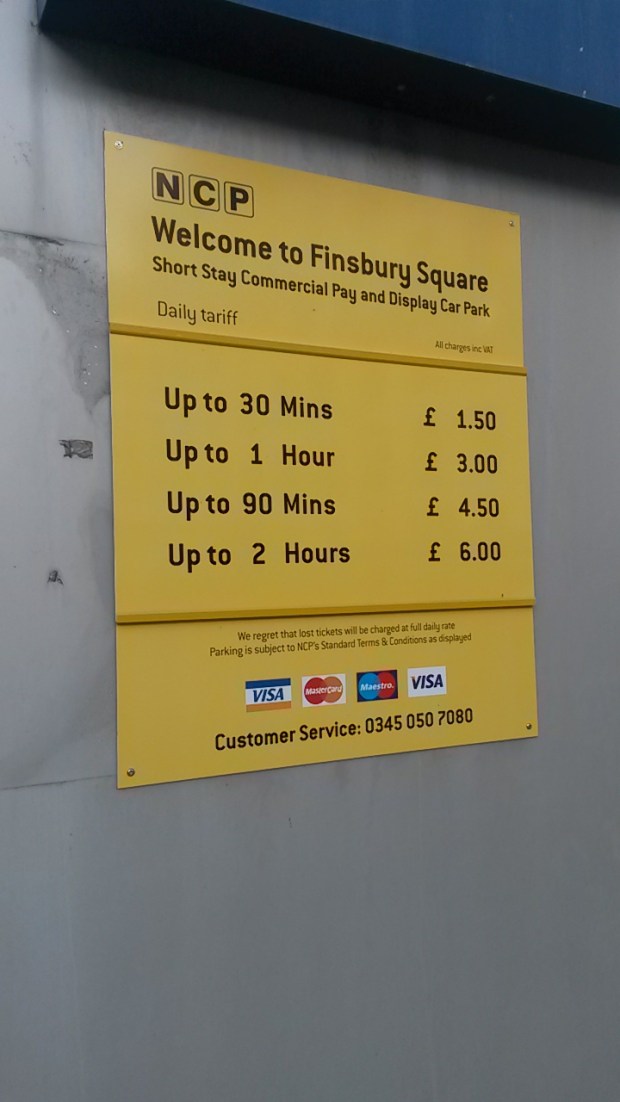
So, that’s £1.50 per half hour, then?

20151120_132545Signage in the city is nothing new, of course. It’s been used for centuries to denote restrictions, instructions, invitations etc. and you’d been forgiven for thinking, given the amount of experience we’ve had, that we had become pretty good at it.
All things being equal, that would be the case however the assumption does not take into account the oddity of human cultures and the differing constructs within the various personal and professional relationships.

The photo shows an advisory poster outside a car park which illustrates that each half hour is charged at £1.50 with what appears to be a maximum length of 2 hours. Rather than simply stating “£1.50 per half hour up to a maximum of 2 hours”, the sign posted as stated the cost of the half hour and further calculated the cost for each additional half hour.

It is a classic example of bureaucratic institance of a notification sign needing to be X by Y measurements without the facility for someone to override the requirement for a simpler, more straightforward message. It could even be argued, the sign failed due to a lack of forethought and oversight. Communication via signage should be defined in its simplicity and clarity.


The Golden Martyr

The Priory Church of St Bartholomew-the-Great sits in West Smithfield in the City of London, quietly confident in its near 900 year history as the oldest church in London and reputedly boasting an interior displaying one of the last remaining examples of Norman architecture.

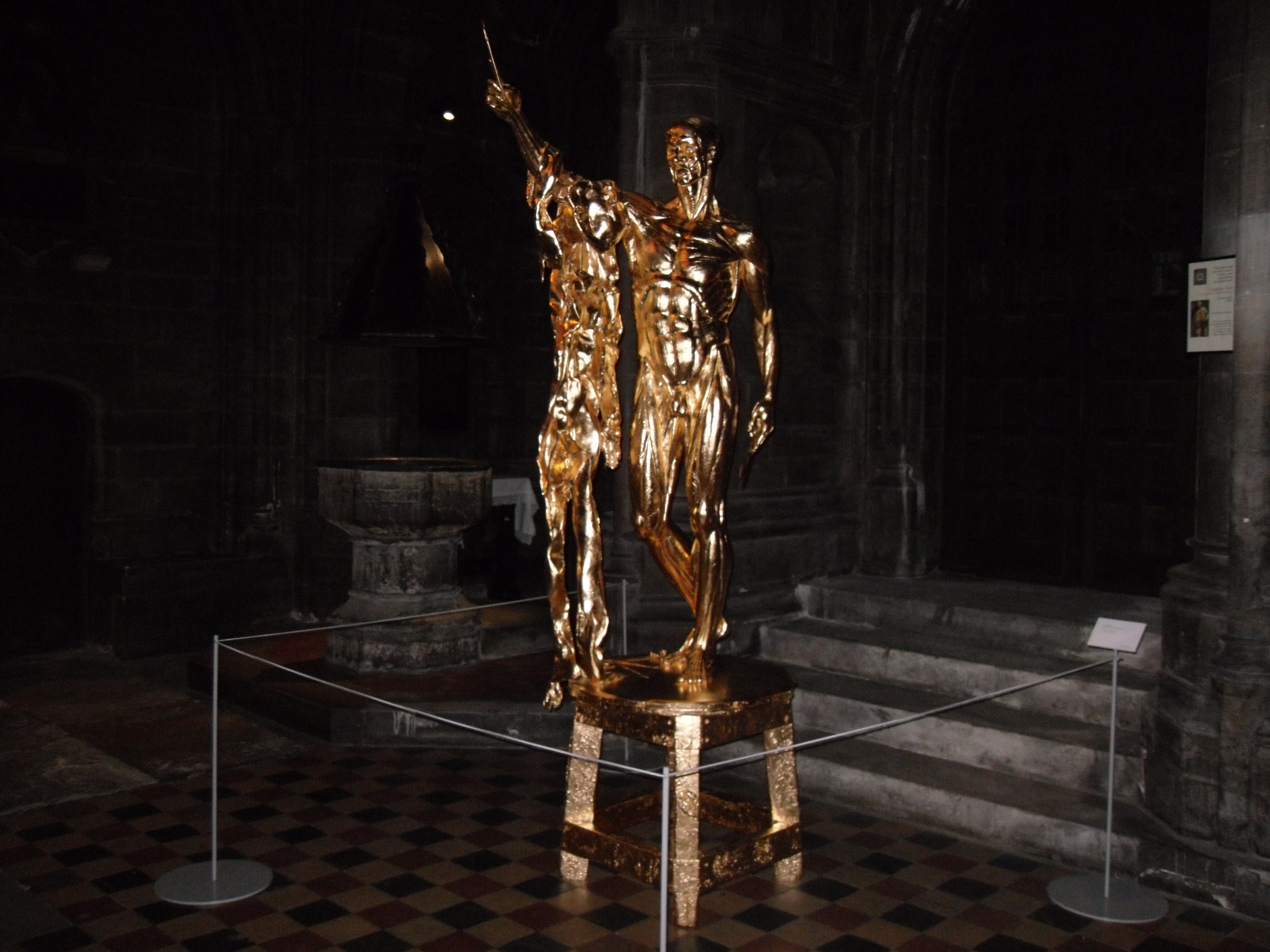
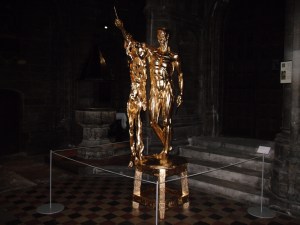
It’s not uncommon for a church to have a sculpture or painting providing some glimpse of the particular saint to whom it has been dedicated but St Barts currently has a more recent addition, that of Exquisite Pain by the artist, Damien Hirst. Among the centuries old pillars and walls, stands an arresting figure of gold. Bartholomew, one of the twelve disciples of Jesus, was flayed alive and the statue depicts a figure standing, holding aloft a scalpel or craft knife while draped over its arm like and old coat is the skin that until recently, protected the body.EP_Front

It is an unsettling image not least because of its visceral content but also because of the quality of the depiction. The bright, garish gold finish is more reminiscent of some frivolous point of sale material of the sort you might find in a shopping centre. Considering the surroundings, it also has a sense of something that has been attacked by vandals like a traditional stone or brass statue spray painted gold EP_Sideor even some bright graffitti that has taken upon itself the virtue of three dimensional form.

In this, past and present come crashing together in a collusion of intent and acceptance. It becomes a somewhat difficult marriage of form and tradition but one that defies your ability to look away.
EP_Below