A recent post by Jeff Allen (http://motherboard.vice.com/read/the-little-known-capitalist-history-of-the-highway-map?utm_source=mbtwitter) sought to describe the influence of cartography in the expansion of capitalism and empire. It’s a fascinating piece detailing how maps have influenced peoples’ choices helping to determine which routes to take based on where they might stop for fuel, food and the like, taking the innocuous and turning it into a means of determinism for governments and businesses alike.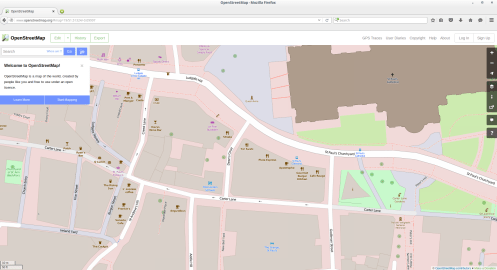
Equally fascinating, however, is the developments brought about in the internet age. An era where free and open source software (determined by the unrestricted access to examine, amend and re-distribute the code) has become the underpinning framework for the web. The free software movement has expanded into other facets including free culture (https://copyleft.org / http://creativecommons.org/). Given that most maps both online and off are governed by copyright, the open culture has reached into cartography, too. This time, in the form of Open Street Map (www.openstreetmap.org).
Initiated by Steve Coast (http://stevecoast.com/) with a similar approach to Wikipedia, volunteers use a variety of resources from ordinance survey maps to GPS records to public domain satellite imagery along with their own, local observations and knowledge to build a rich, freely available and distributable resource, initially of the United Kingdom but also fast including areas further afield.
It’s a fascinating development. Not only does it provide an open alternative to established resources, free of political or commercial interests, it elevates and democratises the input of all users. Since anyone can open an account and edit the maps, providing a first-hand perspective to a particular location, such as “extensive potholes” or “coffee shop”, it becomes a canvas that is being constantly refreshed. It is almost a virtual wall, open to the graffiti of all who visit where the only restrictions being information that is disputed.
As this takes place in cyberspace, it vastly diminishes some of the other hurdles that have previously held back the input of others. It does not require an ongoing subscription. An account is required to edit maps but this is free and does not have to be in your own name. Having made the contribution, you need never log in again. This means there is no barrier to entry, anyone is free to make contributions regardless of their financial backgrounds, geographical location, political or religious viewpoints. The one real requirement is internet access, something which is becoming ever more ubiquitous. Here, the Electric Urbanite has a role to play in the world around them and they’re stepping up to the task.
 bungalooloo