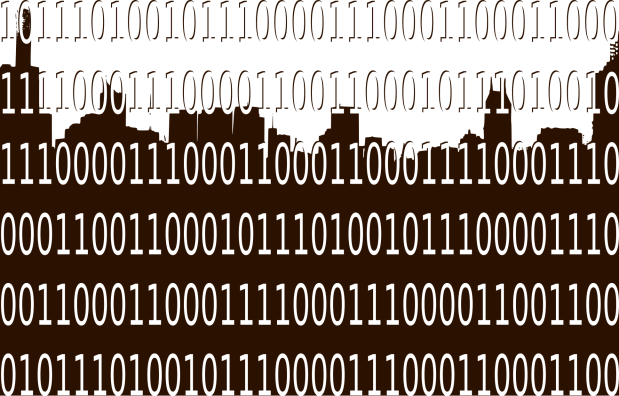
 The modern city has reached a new pinnacle along the route of inevitable progress. The networks that have become imperative to the day to day running of the city, the electricity, gas and water supplies, the street-lights, communication, roadworks, plumbing, sewage and refuse collection. Emergency services, municipal services, local tax collection and allocation, all these and more are run by computers, programmed to run programmes. They automate and facilitate. Systems that allow other systems to run programmes interconnecting, communicating, greasing the wheels needed to turn to allow for services and bureaucracy, both. The city has come to re-define organic. This demi-gaia of overlapping tributaries, networks of elements, cables and precious metals has become an organism in its own right.
The computer, the most fundamental requirement that allows the services to run at the rate we require is feared and elevated in equal measure while the software that runs it is considered in hushed tones and is only for those programmers who understand it. But the software is only the end product of a process that consists of programming languages that appear almost as numerous to the uninitiated as the number of languages spoken by people around the world. It is disconcerting that so many people choose to consider that something so fundamental to their lives is also too far beyond their limit of understanding as to warrant an escapist approach by which understanding is not even attempted. This is even before we explore those means by which people actively take part in the digital universe: interfacing through computers; laptops; tablets; smartphones; smartwatches; kiosks and the like. At every stop, leaving a trail of breadcrumbs, whole encyclopedias of data which relate to everything we do and are there, for the taking, to anyone who wants them.
The programmer, therefore, is a member of one of the most powerful groups active in the world today. A community of makers who fashion the fabric of the modern infrastructure. The programmer is the creator, the maintainer, the controller of the city. While the politicians, businessmen and special interest groups who purport to drive the direction of the infrastructure of the city, act merely as priests bringing offerings to the temple. As Robert (Uncle Bob) Martin explains (1) this status quo will inevitably lead to the code, and the programmer, being held accountable. He calls for the practitioners themselves to consider what they do a profession and to organise themselves as such before the legislators are forced to do so. These “practised hands” (2) wield both a wonderful and potentially terrible power over the world.
For generations we understood that our interactions had ramifications with those around us but we lived in smaller communities and we could believe that what we did behind closed doors stayed there. None of the doors are truly closed in the connected world, however and being connected makes each of us part of the city, real or virtual – it doesn’t matter. The city, with the vast sprawling infrastructure, has a great deal to offer but the potential pitfalls demand we fashion smarter attitudes to accompany our smarter phones, televisions, fridges and the like
1. http://blog.cleancoder.com/
2. McCullough M 1998 A digital craft. The practised digital hand MIT Press, Cambridge, MA
Original image – City Skyline by rgesthuizen via OpenClipArt.org https://openclipart.org/detail/8115/city-skyline
 bungalooloo